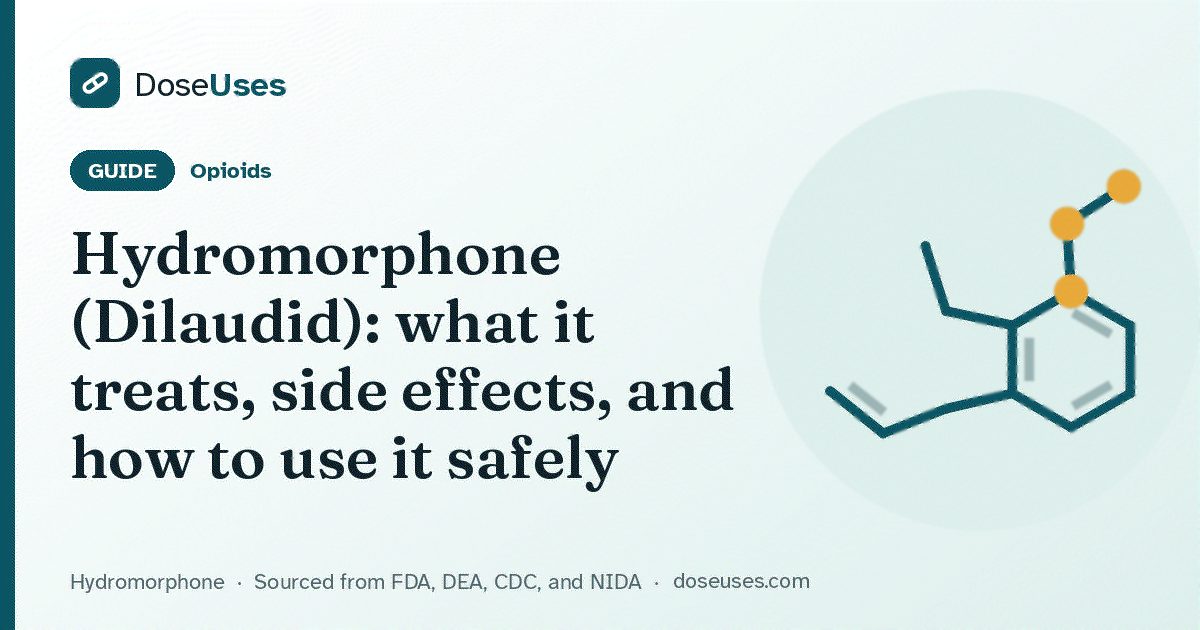
Short answer: Hydromorphone (Dilaudid) is a potent opioid, about five times stronger than morphine by mouth, used for severe pain in hospitals, after surgery, and in cancer care. It is a Schedule II controlled substance with high risks of addiction and overdose.
Key takeaways
- What it is: Hydromorphone is an opioid agonist and a Schedule II controlled substance in the US.
- Main uses: Severe pain.
- Timing: effects start in 15 to 30 minutes and last 3 to 4 hours.
- Most dangerous mix: Benzodiazepines (alprazolam, diazepam, clonazepam), which can cause profound sedation, slowed breathing, coma, death.
- Naloxone: it reverses an overdose.
- Dependence risk: High.
- Legal route: only with a prescription from a DEA-registered clinician, filled by a licensed pharmacy.
What is hydromorphone?
Hydromorphone is approved for pain severe enough to require an opioid when alternatives are inadequate. It is often used in hospitals and in cancer and palliative care, and in people who cannot tolerate morphine. Extended-release tablets are for opioid-tolerant patients only.
Quick facts
| Fact | Hydromorphone |
|---|---|
| Generic name | Hydromorphone hydrochloride |
| Brand names | Dilaudid, Exalgo (extended release) |
| Drug class | Opioid agonist |
| US legal status | Schedule II, prescription only |
| Approved uses | Severe pain requiring an opioid |
| Forms | Tablets, oral liquid, injection, extended-release tablets |
| Onset | 15 to 30 minutes by mouth; 5 minutes IV |
| Half-life | 2 to 3 hours |
| Broken down by | Glucuronidation in the liver |
How long does hydromorphone last?
- Starts working: 15 to 30 minutes
- Effects last: 3 to 4 hours
- Half-life: 2 to 3 hours
Its half-life is 2 to 3 hours. Urine tests usually detect it for 2 to 4 days.
Timing varies with the dose, the form, how it is taken, liver and kidney function, age, and other drugs taken at the same time.
What are the biggest risks of hydromorphone?
The FDA requires boxed warnings, its strongest, on hydromorphone products, including:
- Hydromorphone exposes users to risks of addiction, misuse, and abuse, which can lead to overdose and death.
- Life-threatening slowed breathing can occur, especially when starting treatment or after a dose increase.
- Accidental ingestion, especially by children, can cause a fatal overdose.
- Use with benzodiazepines or other central nervous system depressants, including alcohol, can cause profound sedation, slowed breathing, coma, and death.
Common side effects include constipation, nausea, drowsiness, lightheadedness, itching, and sweating.
What should you never mix with hydromorphone?
| Combined with | What happens | Label guidance |
|---|---|---|
| Benzodiazepines (alprazolam, diazepam, clonazepam) | Profound sedation, slowed breathing, coma, death | Boxed warning; avoid unless no alternative |
| Alcohol | Stronger sedation and slowed breathing | Avoid |
| Gabapentin, pregabalin, sleep medicines, muscle relaxants | Additive sedation and breathing problems | Use caution; lower doses |
| MAOIs | Severe, unpredictable reactions | Avoid within 14 days |
| Anticholinergic drugs | Urinary retention, severe constipation | Use caution |
| Other opioids | Additive breathing suppression | Avoid unless directed by prescriber |
Check any combination with the DoseUses combination checker or ask a pharmacist.
What are the signs of a hydromorphone overdose, and what should you do?
Hydromorphone overdose causes pinpoint pupils, extreme drowsiness, slow or stopped breathing, cold clammy skin, and slow heartbeat.
If someone may have overdosed
- Call 911 if the person is unresponsive, cannot be woken, has blue or gray lips, or is breathing slowly or not at all.
- Give naloxone (Narcan or a generic nasal spray, sold without a prescription) into one nostril. If there is no response after 2 to 3 minutes, give another dose.
- If you are trained, give rescue breaths. Otherwise place the person on their side so they do not choke.
- Stay with them. Naloxone can wear off before hydromorphone does, so the overdose can return even after the person wakes up.
- Most states have Good Samaritan laws that protect people who call 911 for an overdose from some drug charges.
What is hydromorphone withdrawal like, and how long does it last?
People who take hydromorphone regularly for more than a few weeks become physically dependent, even when they take it exactly as prescribed. Dependence is not the same as addiction, but it means stopping suddenly causes withdrawal.
- 6 to 12 hoursEarly symptomsAnxiety, restlessness, yawning, sweating, runny nose, watery eyes, and muscle aches.
- Days 1 to 3Peak withdrawalDiarrhea, stomach cramps, nausea and vomiting, goosebumps, dilated pupils, fast heartbeat, and strong cravings. Rarely dangerous in healthy adults, but dehydration can be serious.
- Days 5 to 10, then weeksLingering symptomsPoor sleep, low mood, low energy, and cravings can continue for weeks. Tolerance falls quickly, which raises the risk of overdose if use restarts.
See the withdrawal timelines and the full hydromorphone withdrawal guide.
Is hydromorphone legal?
In the United States, hydromorphone is a Schedule II controlled substance. The only legal way to get it is with a prescription from a clinician registered with the Drug Enforcement Administration (DEA), filled by a licensed pharmacy. Depending on state law, that can be a physician, nurse practitioner, or physician assistant.
- Refills: Schedule II prescriptions cannot be refilled. A prescriber can write several prescriptions at once, with dates when each may be filled, for up to a 90-day supply in total.
- Telehealth: federal flexibilities let DEA-registered clinicians prescribe Schedule II to V medicines after a telemedicine visit, without a prior in-person exam, through December 31, 2026. A permanent DEA rule was under final review in late 2026. State rules can be stricter.
- Monitoring: prescribers and pharmacists in most states check a prescription drug monitoring program, a database of controlled-substance prescriptions, before prescribing or dispensing.
Outside the United States
| Country | Status |
|---|---|
| United Kingdom | Class A; prescription only |
| Canada | Schedule I of the Controlled Drugs and Substances Act; prescription only |
| Australia | Schedule 8 controlled drug; prescription only |
| International | Schedule I of the 1961 Single Convention on Narcotic Drugs |
Frequently asked questions about hydromorphone
How strong is hydromorphone compared with morphine?
By mouth it is roughly 4 to 5 times as potent as morphine per milligram; by injection the ratio is higher.
What is Dilaudid?
Dilaudid is the brand name for hydromorphone.
How long does hydromorphone stay in your system?
Its half-life is 2 to 3 hours. Urine tests usually detect it for 2 to 4 days.
Can you drink alcohol with hydromorphone?
No. Alcohol increases sedation and the risk of fatal breathing problems, and it can make extended-release tablets release drug faster.
Sources
- Dilaudid (hydromorphone) prescribing information, DailyMed, US National Library of Medicine.
- Information about naloxone and nalmefene, US Food and Drug Administration.
- CDC Clinical Practice Guideline for Prescribing Opioids for Pain, 2022, Centers for Disease Control and Prevention, MMWR.
- Controlled Substance Schedules, DEA Diversion Control Division.
- 21 CFR 1306.12, Refilling prescriptions; issuance of multiple prescriptions (Schedule II), Electronic Code of Federal Regulations.
- Prescribing controlled substances via telehealth, US Department of Health and Human Services.
- BeSafeRx: Your Source for Online Pharmacy Information, US Food and Drug Administration.
- Safe Pharmacy, National Association of Boards of Pharmacy.
This guide summarizes the sourced DoseUses Hydromorphone profile, written from FDA labels, DEA rules, and federal health agencies. It is educational and is not medical advice. Last updated October 5, 2026.