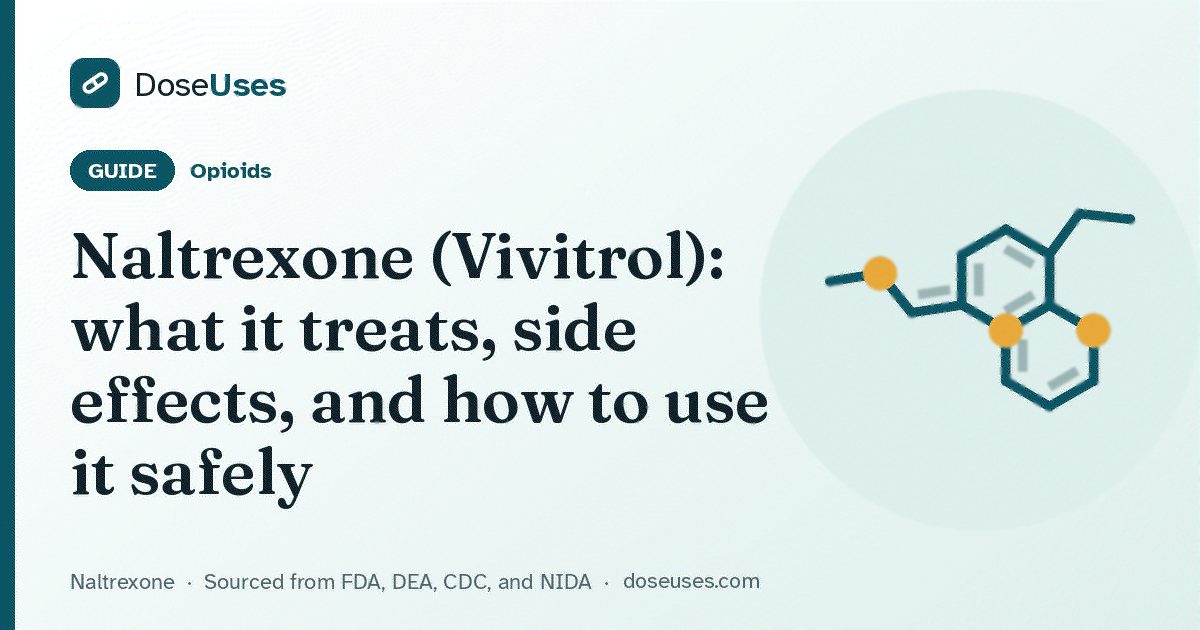
Short answer: Naltrexone is a prescription medicine that blocks opioid receptors. It treats alcohol use disorder and, after detox, opioid use disorder, as a daily pill or a monthly injection (Vivitrol). It is not a controlled substance, is not addictive, and any licensed prescriber can prescribe it.
Key takeaways
- What it is: Naltrexone is an opioid antagonist and not a federally controlled substance.
- Main uses: Alcohol use disorder; opioid use disorder.
- Timing: effects start in about 1 hour (tablets) and last 24 to 72 hours (tablets); about 1 month (injection).
- Most dangerous mix: Opioids taken to override the block, which can cause overdose and death.
- Naloxone: it does not reverse this drug, but give it whenever opioids could be involved.
- Dependence risk: None.
- Legal route: prescription only, filled by a licensed pharmacy.
What is naltrexone?
Naltrexone reduces heavy drinking and cravings in alcohol use disorder, and blocks the effects of opioids to help prevent relapse after someone has fully withdrawn from opioids.
Unlike buprenorphine and methadone, naltrexone does not activate opioid receptors. People must be opioid-free for 7 to 10 days before starting, or 7 to 14 days after long-acting opioids, to avoid sudden withdrawal.
Quick facts
| Fact | Naltrexone |
|---|---|
| Generic name | Naltrexone hydrochloride |
| Brand names | Vivitrol (extended-release injection); Revia (tablets, discontinued brand) |
| Drug class | Opioid antagonist |
| US legal status | Prescription only; not a controlled substance |
| Approved uses | Alcohol dependence; prevention of relapse to opioid dependence after detox |
| Forms | 50 mg tablets; 380 mg monthly injection |
| Onset | About 1 hour (tablets) |
| Half-life | About 4 hours; 6-beta-naltrexol about 13 hours |
| Combined with | Bupropion in Contrave for weight management |
How long does naltrexone last?
- Starts working: About 1 hour (tablets)
- Effects last: 24 to 72 hours (tablets); about 1 month (injection)
- Half-life: About 4 hours; 6-beta-naltrexol about 13 hours
Timing varies with the dose, the form, how it is taken, liver and kidney function, age, and other drugs taken at the same time.
What are the biggest risks of naltrexone?
Common side effects include nausea, headache, dizziness, tiredness, and trouble sleeping. Injection-site reactions, sometimes severe, can occur with Vivitrol.
Overdose after stopping: naltrexone lowers opioid tolerance. Taking opioids after a missed dose, after the injection wears off, or in an attempt to override the blockade can cause a fatal overdose.
Liver: liver injury has been reported at high doses. An earlier boxed warning about liver toxicity was removed in 2013, but liver tests are checked in people with liver disease.
What should you never mix with naltrexone?
| Combined with | What happens | Label guidance |
|---|---|---|
| Opioid pain medicines, cough and diarrhea medicines with opioids | Blocked effect; little or no relief | Plan pain care in advance; carry a wallet card |
| Opioids taken to override the block | Overdose and death | Dangerous |
| Methadone or buprenorphine | Sudden, severe withdrawal | Do not combine |
| Alcohol | No dangerous interaction; may reduce the urge to drink | Can be started while still drinking |
Check any combination with the DoseUses combination checker or ask a pharmacist.
What are the signs of a naltrexone overdose, and what should you do?
Naltrexone itself has a wide safety margin. The danger is opioid overdose: in people whose tolerance has dropped, or who take large amounts of opioids to overcome the blockade.
If someone may have overdosed
- Call 911 if the person is unresponsive, cannot be woken, has blue or gray lips, or is breathing slowly or not at all.
- Give naloxone (Narcan or a generic nasal spray, sold without a prescription) into one nostril. If there is no response after 2 to 3 minutes, give another dose.
- If you are trained, give rescue breaths. Otherwise place the person on their side so they do not choke.
- Stay with them. Naloxone can wear off before naltrexone does, so the overdose can return even after the person wakes up.
- Most states have Good Samaritan laws that protect people who call 911 for an overdose from some drug charges.
Does naltrexone cause withdrawal?
Naltrexone does not cause physical dependence, and stopping it does not cause withdrawal. Starting it while opioids are still in the body causes sudden opioid withdrawal, which is why people must be opioid-free first.
- Minutes to hoursPrecipitated withdrawalIf taken too soon after opioids: vomiting, diarrhea, sweating, agitation, and body aches.
- Day 1 to 2PeakSymptoms can be intense after an injection, which cannot be removed, and may need hospital care.
- After stoppingNo withdrawalOpioid tolerance stays low, so any return to opioid use carries a high risk of overdose.
See the withdrawal timelines and the full naltrexone withdrawal guide.
Is naltrexone legal?
In the United States, naltrexone is a prescription medicine but not a controlled substance. Any licensed prescriber can prescribe it, including in primary care and by telemedicine, without a DEA registration.
- Refills: refills follow ordinary prescription rules.
- Pharmacies: a legitimate pharmacy always requires a valid prescription, has a licensed pharmacist available, and is licensed in the state it ships to. The FDA's BeSafeRx tool and the NABP's safe pharmacy list help confirm a pharmacy is real.
- Cost: generic tablets are inexpensive. Vivitrol costs over $1,500 per injection without insurance but is covered by Medicaid and most insurers, often with prior authorization.
Outside the United States
| Country | Status |
|---|---|
| United Kingdom | Prescription-only medicine |
| Canada | Prescription only |
| Australia | Schedule 4 prescription medicine |
| International | Not under UN control |
Frequently asked questions about naltrexone
Is naltrexone addictive?
No. It has no opioid effects, does not cause a high, and does not cause withdrawal when stopped.
Can you drink alcohol on naltrexone?
It is safe to drink, and some programs start it while people are still drinking, but it is meant to help reduce drinking.
What is low-dose naltrexone (LDN)?
Doses of about 1 to 4.5 mg, usually compounded, are used off-label for chronic pain and autoimmune conditions. Evidence is limited and the FDA has not approved these uses.
How is naltrexone different from naloxone?
Both block opioid receptors. Naloxone works fast and briefly to reverse overdose; naltrexone lasts a day to a month to prevent relapse.
Can naltrexone help with weight loss?
Combined with bupropion in Contrave, it is approved for weight management.
Sources
- Vivitrol (naltrexone) prescription information, DailyMed, US National Library of Medicine.
- BeSafeRx: Your Source for Online Pharmacy Information, US Food and Drug Administration.
- Safe Pharmacy, National Association of Boards of Pharmacy.
- One Pill Can Kill, US Drug Enforcement Administration.
- International drug control conventions, United Nations Office on Drugs and Crime.
This guide summarizes the sourced DoseUses Naltrexone profile, written from FDA labels, DEA rules, and federal health agencies. It is educational and is not medical advice. Last updated October 5, 2026.