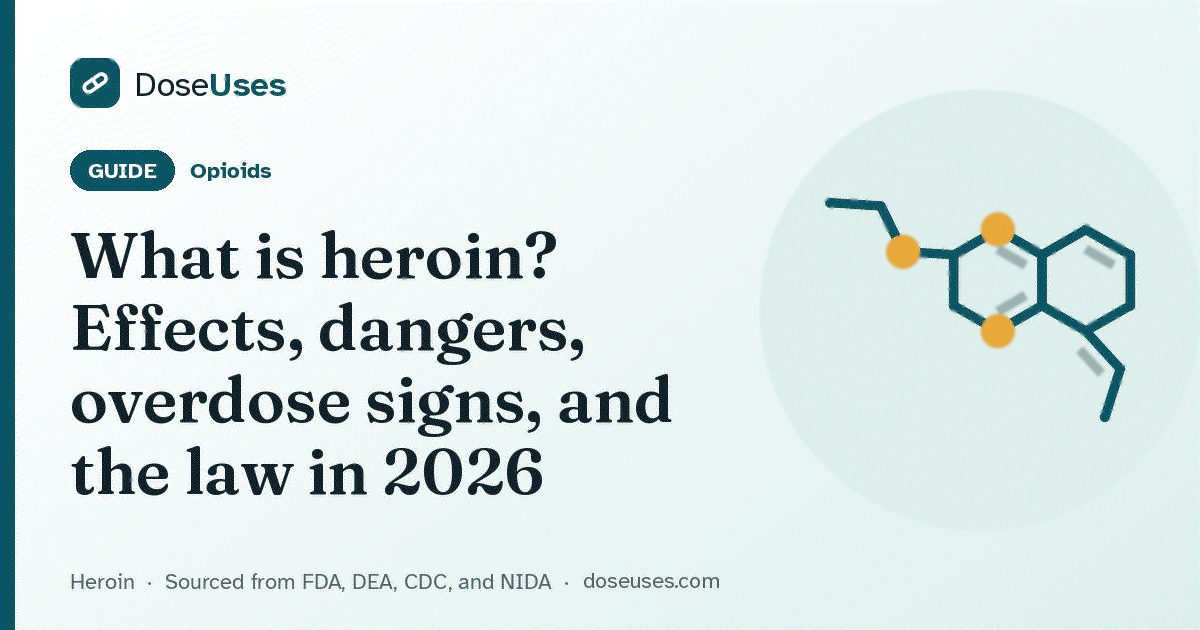
Short answer: Heroin is an illegal opioid made from morphine. It is a Schedule I controlled substance in the US, with no accepted medical use. Most of the US heroin supply has been replaced or contaminated by fentanyl, which has made overdose far more likely. Effective treatment with buprenorphine or methadone is widely available.
Key takeaways
- What it is: Heroin is an opioid agonist (semi-synthetic) and a Schedule I controlled substance in the US.
- Medical use: None in the US.
- Timing: effects start in seconds to minutes and last 3 to 5 hours.
- Most dangerous mix: Fentanyl (often present without the buyer knowing), which can cause much higher overdose risk.
- Naloxone: it reverses an overdose.
- Dependence risk: Very high.
- Legal route: none. Schedule I substances cannot be prescribed.
What is heroin?
Heroin is made by chemically modifying morphine from the opium poppy. It crosses into the brain faster than morphine and is then converted back to morphine, which produces an intense rush followed by sedation.
Heroin causes a surge of euphoria, flushed skin, dry mouth, and heavy limbs, followed by hours of drowsiness, clouded thinking, slowed heart rate, and slowed breathing ("nodding").
Quick facts
| Fact | Heroin |
|---|---|
| Chemical name | Diacetylmorphine (diamorphine) |
| Street names | Dope, smack, H, black tar, junk |
| Drug class | Semi-synthetic opioid agonist |
| US legal status | Schedule I; no accepted medical use |
| Medical use elsewhere | Prescribed as diamorphine in the UK and for treatment in several European countries and Canada |
| How it is used | Injected, smoked, or snorted |
| Onset | Seconds (injected) to minutes |
| Duration | 3 to 5 hours |
| Half-life | Minutes; converted to morphine |
How long does heroin last?
- Starts working: Seconds to minutes
- Effects last: 3 to 5 hours
- Half-life: Minutes; converted to morphine
Heroin is converted to morphine within minutes. Urine tests detect morphine and the heroin marker 6-MAM for about 1 to 3 days.
Timing varies with the dose, the form, how it is taken, liver and kidney function, age, and other drugs taken at the same time.
What are the biggest risks of heroin?
Overdose: heroin slows and can stop breathing. The risk is highest with fentanyl contamination, after a period without use, and with alcohol or benzodiazepines.
Addiction: heroin is highly addictive. Tolerance builds quickly, and physical dependence develops within weeks of regular use.
Injection risks: HIV and hepatitis C from shared needles, skin abscesses, heart valve infections (endocarditis), and collapsed veins. Syringe services programs provide sterile equipment and reduce infections without increasing drug use.
What should you never mix with heroin?
| Combined with | What happens | Risk level |
|---|---|---|
| Fentanyl (often present without the buyer knowing) | Much higher overdose risk | Leading cause of overdose deaths |
| Alcohol | Additive breathing suppression | Very high risk |
| Benzodiazepines, pills sold as Xanax | Profound sedation, stopped breathing | Very high risk |
| Cocaine or methamphetamine ("speedball") | Overdose when the stimulant wears off; heart strain | Very high risk |
| Xylazine | Deep sedation not reversed by naloxone; wounds | Give naloxone anyway and call 911 |
Check any combination with the DoseUses combination checker or ask a pharmacist.
What are the signs of a heroin overdose, and what should you do?
Signs of heroin overdose include pinpoint pupils, unresponsiveness, slow, shallow, or stopped breathing, gurgling or snoring, and blue or gray lips and fingertips.
If someone may have overdosed
- Call 911 if the person is unresponsive, cannot be woken, has blue or gray lips, or is breathing slowly or not at all.
- Give naloxone (Narcan or a generic nasal spray, sold without a prescription) into one nostril. If there is no response after 2 to 3 minutes, give another dose.
- If you are trained, give rescue breaths. Otherwise place the person on their side so they do not choke.
- Stay with them. Naloxone can wear off before heroin does, so the overdose can return even after the person wakes up.
- Most states have Good Samaritan laws that protect people who call 911 for an overdose from some drug charges.
Is heroin addictive, and what is withdrawal like?
Heroin is one of the most addictive drugs. Opioid use disorder is a treatable medical condition, and medicines are the most effective treatment.
- 6 to 12 hoursEarly withdrawalAnxiety, yawning, runny nose, sweating, aching muscles, cravings.
- Days 1 to 3Peak withdrawalDiarrhea, vomiting, stomach cramps, goosebumps, insomnia, dilated pupils.
- Days 5 to 10, then weeksLingering symptomsFatigue, low mood, poor sleep, and cravings.
See the withdrawal timelines and the full heroin withdrawal guide.
Is heroin legal?
Heroin is a Schedule I controlled substance, meaning federal law considers it to have a high potential for abuse and no accepted medical use in the US. It cannot be prescribed.
- Possession: under federal law, a first conviction for possessing any controlled substance without a valid prescription can bring up to one year in prison and a minimum fine of $1,000. Penalties rise with prior convictions.
- Trafficking: trafficking 100 grams or more of a mixture containing heroin carries a mandatory minimum of 5 years in federal prison, and 1 kilogram or more carries 10 years. If death or serious injury results, the minimum is 20 years.
- State law: states set their own penalties, and most drug cases are prosecuted under state law. Penalties range from a civil fine to long prison terms depending on the state, the amount, and prior record.
Outside the United States
| Country | Status |
|---|---|
| United Kingdom | Class A; diamorphine prescribed medically |
| Canada | Schedule I; prescribed diacetylmorphine for some patients in treatment |
| Switzerland | Prohibited except in heroin-assisted treatment programs |
| International | Schedule I and IV of the 1961 Single Convention |
Frequently asked questions about heroin
Is heroin the same as fentanyl?
No, but most drugs sold as heroin in the US now contain fentanyl, which is far stronger and causes most overdose deaths.
Does naloxone work on heroin?
Yes. Naloxone reverses heroin and fentanyl overdose. It is sold without a prescription.
How long does heroin stay in your system?
Heroin is converted to morphine within minutes. Urine tests detect morphine and the heroin marker 6-MAM for about 1 to 3 days.
Is heroin used in medicine anywhere?
Yes. In the UK it is prescribed as diamorphine for severe pain, and several countries use it in supervised treatment programs.
What is the best treatment for heroin addiction?
Medications for opioid use disorder, buprenorphine or methadone, combined with support. They reduce overdose deaths by about half.
Sources
- Heroin DrugFacts, National Institute on Drug Abuse.
- Fentanyl DrugFacts, National Institute on Drug Abuse.
- FDA alerts health care professionals of risks to patients exposed to xylazine in illicit drugs, US Food and Drug Administration.
- Information about naloxone and nalmefene, US Food and Drug Administration.
- Controlled Substance Schedules, DEA Diversion Control Division.
- 21 U.S.C. 844, Penalties for simple possession, Legal Information Institute, Cornell Law School.
- 21 U.S.C. 841, Prohibited acts A (trafficking penalties), Legal Information Institute, Cornell Law School.
- Expansion of Buprenorphine Treatment via Telemedicine Encounter, final rule, Federal Register, January 17, 2025.
This guide summarizes the sourced DoseUses Heroin profile, written from FDA labels, DEA rules, and federal health agencies. It is educational and is not medical advice. Last updated October 5, 2026.