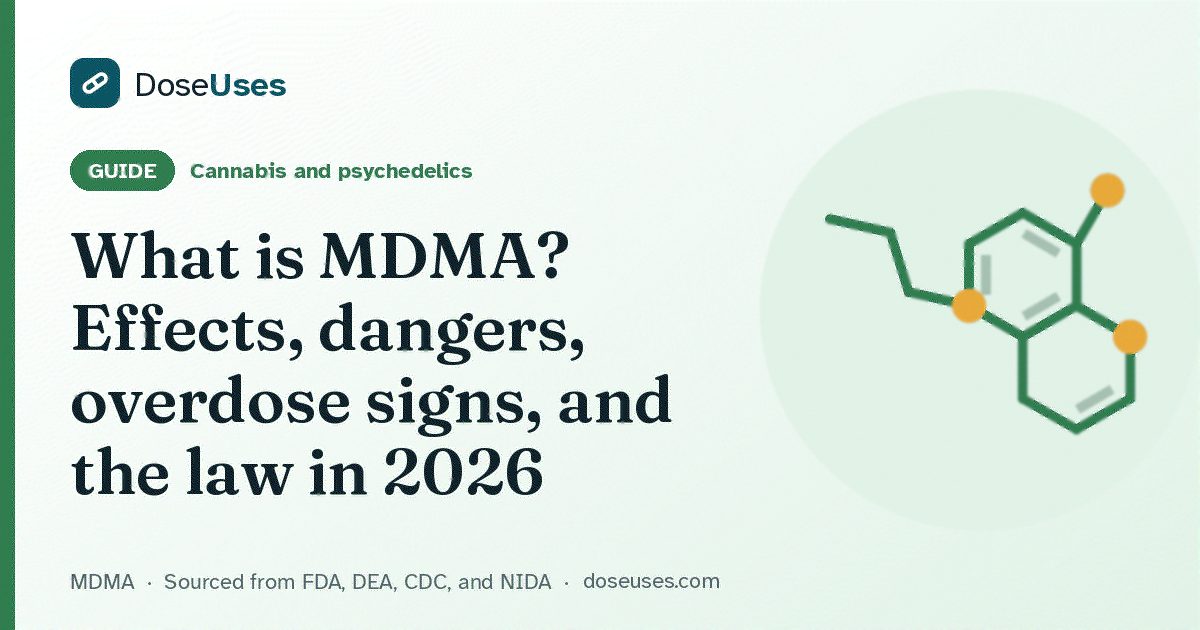
Short answer: MDMA, sold as ecstasy or molly, is a stimulant and empathy-enhancing drug that releases large amounts of serotonin. It is Schedule I in the US. Main dangers are overheating, dangerously low sodium from drinking too much water, serotonin syndrome, and pills or powders that contain other drugs. The FDA declined to approve MDMA-assisted therapy for PTSD in 2024.
Key takeaways
- What it is: MDMA is an entactogen (amphetamine derivative) and a Schedule I controlled substance in the US.
- Medical use: Investigational (PTSD).
- Timing: effects start in 30 to 60 minutes and last 3 to 6 hours.
- Most dangerous mix: MAOIs (including some antidepressants and ayahuasca), which can cause severe serotonin syndrome; potentially fatal.
- Naloxone: it does not reverse this drug, but give it whenever opioids could be involved.
- Dependence risk: Low to moderate.
- Legal route: none. Schedule I substances cannot be prescribed.
What is MDMA?
MDMA releases serotonin, dopamine, and norepinephrine and raises oxytocin, which produces euphoria, energy, and feelings of closeness. It was patented in 1912, used in therapy in the 1970s and 1980s, and placed in Schedule I in 1985.
MDMA causes euphoria, emotional warmth, energy, heightened senses, and talkativeness, along with jaw clenching, teeth grinding, sweating, raised heart rate and blood pressure, and higher body temperature.
Quick facts
| Fact | MDMA |
|---|---|
| Chemical name | 3,4-methylenedioxymethamphetamine (midomafetamine) |
| Street names | Ecstasy, molly, E, X |
| Drug class | Entactogen; amphetamine derivative |
| US legal status | Schedule I |
| Medical status | Investigational; FDA declined approval for PTSD in 2024 |
| How it is used | Pills, capsules, powder or crystals swallowed or snorted |
| Onset | 30 to 60 minutes |
| Duration | 3 to 6 hours |
| Half-life | About 8 hours |
How long does MDMA last?
- Starts working: 30 to 60 minutes
- Effects last: 3 to 6 hours
- Half-life: About 8 hours
Urine tests usually detect it for 2 to 4 days.
Timing varies with the dose, the form, how it is taken, liver and kidney function, age, and other drugs taken at the same time.
What are the biggest risks of MDMA?
Overheating: MDMA impairs temperature control. In hot, crowded settings with dancing, body temperature can rise high enough to cause muscle breakdown, kidney failure, and death.
Low sodium (hyponatremia): MDMA causes the body to hold water. Drinking large amounts of water can dilute blood sodium and cause brain swelling, seizures, and death. Sipping about 500 mL (a pint) an hour while active is a common harm reduction guide.
Adulterants: pills and powders sold as ecstasy or molly often contain synthetic cathinones ("bath salts"), methamphetamine, or ketamine, and sometimes fentanyl.
What should you never mix with MDMA?
| Combined with | What happens | Risk level |
|---|---|---|
| MAOIs (including some antidepressants and ayahuasca) | Severe serotonin syndrome; potentially fatal | Avoid |
| SSRIs, SNRIs, tramadol, dextromethorphan | Serotonin syndrome; SSRIs also blunt effects | High risk |
| Ritonavir and some HIV medicines | Sharply raise MDMA levels; deaths reported | Avoid |
| Stimulants, alcohol | Overheating, dehydration, heart strain | High risk |
| Lithium | Seizures reported | Avoid |
Check any combination with the DoseUses combination checker or ask a pharmacist.
What are the signs of a MDMA overdose, and what should you do?
Warning signs include feeling very hot or not sweating despite heat, confusion, muscle rigidity or twitching, a racing heartbeat, severe headache, vomiting, fainting, and seizures. Severe headache, confusion, and vomiting after heavy water intake can signal low sodium.
If someone may be overdosing
- Call 911 for chest pain, a seizure, trouble breathing, signs of a stroke (face drooping, weakness on one side, slurred speech), a very high body temperature, or if the person collapses.
- Move them somewhere cool and calm, loosen tight clothing, and cool the skin with water. Do not try to hold them down.
- If they become unresponsive or their breathing slows, give naloxone. Street stimulants are often contaminated with fentanyl.
- For advice when the person is awake and stable, call Poison Help at 1-800-222-1222.
Is MDMA addictive, and what is withdrawal like?
MDMA is less addictive than other stimulants, but some people use it compulsively. After use, a "comedown" of low mood, fatigue, and poor concentration commonly lasts several days.
- Days 1 to 2ComedownFatigue, low mood, irritability, poor appetite.
- Days 3 to 5Midweek lowLow mood and anxiety may peak.
- WeeksRecoveryMood normalizes; frequent use slows recovery.
See the withdrawal timelines and the full MDMA withdrawal guide.
Is MDMA legal?
MDMA is a Schedule I controlled substance under federal law, meaning it is considered to have a high potential for abuse and no currently accepted medical use. It cannot be prescribed, and possessing, making, or selling it is a federal crime.
- Possession: under federal law, a first conviction for possessing any controlled substance without a valid prescription can bring up to one year in prison and a minimum fine of $1,000. Penalties rise with prior convictions.
- Selling or sharing: distribution carries much heavier federal penalties, which increase with the amount involved and are higher still if the drug causes death or serious injury.
- State law: states set their own penalties, and most drug cases are prosecuted under state law. Penalties range from a civil fine to long prison terms depending on the state, the amount, and prior record.
Outside the United States
| Country | Status |
|---|---|
| Australia | Schedule 8 for prescribing by authorised psychiatrists for PTSD since 2023; otherwise prohibited |
| United Kingdom | Class A |
| Canada | Schedule I |
| International | Schedule I of the 1971 Convention on Psychotropic Substances |
Frequently asked questions about MDMA
Is molly the same as ecstasy?
Both names refer to MDMA. "Molly" was marketed as pure powder, but tests show both often contain other drugs.
How much water should you drink on MDMA?
Harm reduction groups advise sipping about 500 mL (a pint) an hour if active, less if resting. Too much water can be fatal.
Is MDMA approved for PTSD?
Not in the US. The FDA declined approval in 2024. Australia allows authorised psychiatrists to prescribe it.
Can you take MDMA with antidepressants?
MAOIs combined with MDMA can be fatal. SSRIs and SNRIs blunt its effects and can contribute to serotonin syndrome.
How long does MDMA stay in your system?
Urine tests usually detect it for 2 to 4 days.
Sources
- MDMA (Ecstasy/Molly), National Institute on Drug Abuse.
- Change to classification of psilocybin and MDMA to enable prescribing by authorised psychiatrists, Therapeutic Goods Administration, Australia.
- Controlled Substance Schedules, DEA Diversion Control Division.
- 21 U.S.C. 844, Penalties for simple possession, Legal Information Institute, Cornell Law School.
- 21 U.S.C. 841, Prohibited acts A (trafficking penalties), Legal Information Institute, Cornell Law School.
- Executive order aims to accelerate approval of therapeutic psychedelics, Morgan Lewis, April 2026.
- National Helpline, Substance Abuse and Mental Health Services Administration.
- FindTreatment.gov, Substance Abuse and Mental Health Services Administration.
This guide summarizes the sourced DoseUses MDMA profile, written from FDA labels, DEA rules, and federal health agencies. It is educational and is not medical advice. Last updated October 5, 2026.