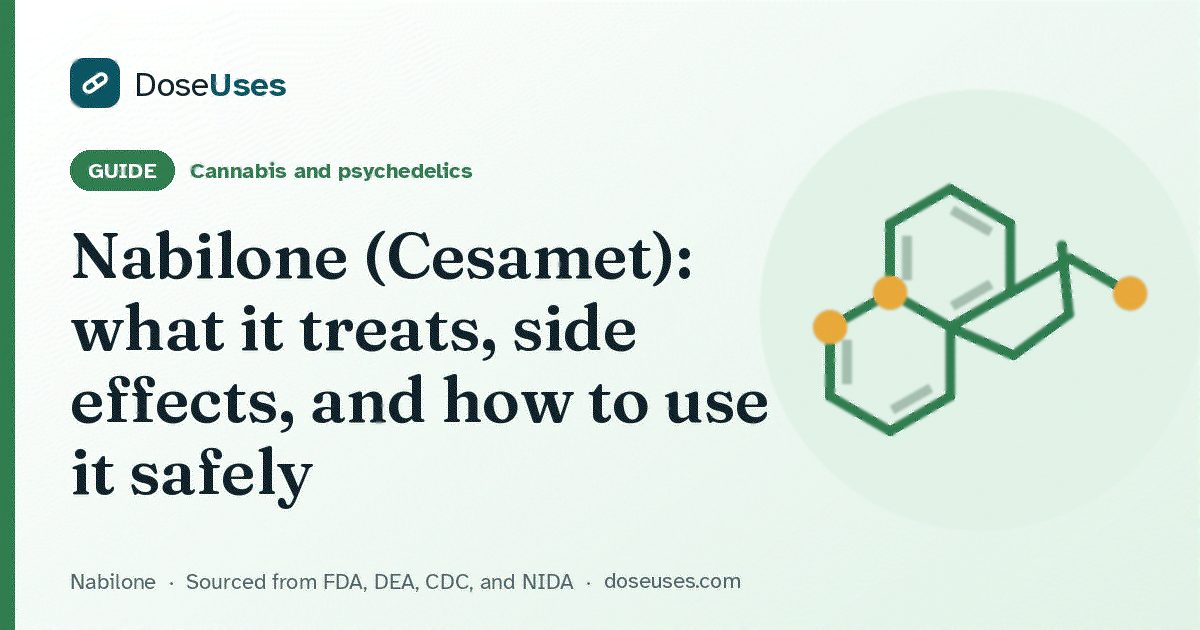
Short answer: Nabilone (Cesamet) is a prescription synthetic cannabinoid, similar to THC, for nausea and vomiting from chemotherapy that has not responded to standard medicines. It is a Schedule II controlled substance. It commonly causes drowsiness, dizziness, and changes in mood.
Key takeaways
- What it is: Nabilone is a synthetic cannabinoid (prescription) and a Schedule II controlled substance in the US.
- Main uses: Chemotherapy-induced nausea and vomiting.
- Timing: effects start in 60 to 90 minutes and last 8 to 12 hours.
- Most dangerous mix: Alcohol, benzodiazepines, opioids, sleep medicines, which can cause additive sedation and impairment.
- Naloxone: it does not reverse this drug, but give it whenever opioids could be involved.
- Dependence risk: Moderate.
- Legal route: only with a prescription from a DEA-registered clinician, filled by a licensed pharmacy.
What is nabilone?
Nabilone treats nausea and vomiting from cancer chemotherapy when standard antiemetics have not worked. It is related to dronabinol (synthetic THC) but is a different molecule.
It is sometimes used off-label for chronic pain or sleep, particularly in Canada, where it has long been available.
Quick facts
| Fact | Nabilone |
|---|---|
| Generic name | Nabilone |
| Brand names | Cesamet |
| Drug class | Synthetic cannabinoid; CB1 and CB2 receptor agonist |
| US legal status | Schedule II, prescription only |
| Approved uses | Chemotherapy-induced nausea and vomiting not responding to conventional antiemetics |
| Forms | 1 mg capsules |
| Onset | 60 to 90 minutes |
| Half-life | About 2 hours; metabolites about 35 hours |
How long does nabilone last?
- Starts working: 60 to 90 minutes
- Effects last: 8 to 12 hours
- Half-life: About 2 hours; metabolites about 35 hours
Timing varies with the dose, the form, how it is taken, liver and kidney function, age, and other drugs taken at the same time.
What are the biggest risks of nabilone?
Common side effects include drowsiness, dizziness, dry mouth, euphoria, and trouble concentrating.
Psychiatric effects: anxiety, confusion, depression, and hallucinations, particularly in people with a history of mental illness.
Heart and blood pressure: fast heartbeat and low blood pressure on standing.
What should you never mix with nabilone?
| Combined with | What happens | Label guidance |
|---|---|---|
| Alcohol, benzodiazepines, opioids, sleep medicines | Additive sedation and impairment | Avoid or use caution |
| Stimulants and anticholinergics | Fast heartbeat | Monitor |
| Other cannabis products | Stronger psychoactive effects | Avoid |
Check any combination with the DoseUses combination checker or ask a pharmacist.
What are the signs of a nabilone overdose, and what should you do?
Overdose can cause extreme drowsiness, confusion, hallucinations, anxiety, fast heartbeat, and low blood pressure.
If someone is having a dangerous reaction
- Call 911 for a seizure, chest pain, a very high temperature, trouble breathing, unresponsiveness, or if the person may harm themselves or others.
- Move them to a quiet, safe place away from roads, water, heights, and crowds. Stay with them and speak calmly.
- Do not leave the person alone and do not give them other drugs or alcohol to calm them down.
- If they become unresponsive, place them on their side and give naloxone in case opioids are involved.
What is nabilone withdrawal like, and how long does it last?
Short courses during chemotherapy rarely cause dependence. Long-term use can cause cannabis-like withdrawal when stopped.
- Days 1 to 3Possible symptomsIrritability, insomnia, and restlessness.
- Days 3 to 7PeakLow mood, sweating, and appetite changes.
- 1 to 2 weeksResolvesSymptoms fade.
See the withdrawal timelines and the full nabilone withdrawal guide.
Is nabilone legal?
In the United States, nabilone is a Schedule II controlled substance. The only legal way to get it is with a prescription from a clinician registered with the Drug Enforcement Administration (DEA), filled by a licensed pharmacy. Depending on state law, that can be a physician, nurse practitioner, or physician assistant.
- Refills: Schedule II prescriptions cannot be refilled. A prescriber can issue several prescriptions at once, each dated with the earliest fill date, for up to a 90-day supply.
- Telehealth: federal flexibilities let DEA-registered clinicians prescribe Schedule II to V medicines after a telemedicine visit, without a prior in-person exam, through December 31, 2026. A permanent DEA rule was under final review in late 2026. State rules can be stricter.
- Monitoring: prescribers and pharmacists in most states check a prescription drug monitoring program, a database of controlled-substance prescriptions, before prescribing or dispensing.
Outside the United States
| Country | Status |
|---|---|
| Canada | Prescription only; widely used |
| United Kingdom | Prescription-only medicine; controlled drug |
| International | Not under UN control |
Frequently asked questions about nabilone
Is nabilone the same as THC?
No. It is a synthetic molecule that acts on the same cannabinoid receptors as THC.
Is nabilone the same as dronabinol?
No. Dronabinol is synthetic THC; nabilone is a related but different compound.
Does nabilone show up on a drug test?
Standard THC tests may not detect it, but specific tests can.
Can nabilone be used for pain?
Only off-label; evidence is limited.
Is nabilone addictive?
It has misuse potential and is Schedule II.
Sources
- Cesamet (nabilone) prescription information, DailyMed, US National Library of Medicine.
- Controlled Substance Schedules, DEA Diversion Control Division.
- 21 CFR 1306.12, Refilling prescriptions; issuance of multiple prescriptions (Schedule II), Electronic Code of Federal Regulations.
- Prescribing controlled substances via telehealth, US Department of Health and Human Services.
- BeSafeRx: Your Source for Online Pharmacy Information, US Food and Drug Administration.
- Safe Pharmacy, National Association of Boards of Pharmacy.
- One Pill Can Kill, US Drug Enforcement Administration.
- International drug control conventions, United Nations Office on Drugs and Crime.
This guide summarizes the sourced DoseUses Nabilone profile, written from FDA labels, DEA rules, and federal health agencies. It is educational and is not medical advice. Last updated October 5, 2026.